The Struggle For Self Determination
When you ask the current leaders of the Griqua where they strive for, they will certainly answer ‘for self determination’. First of all the Griqua heritage has to be restored and a new consciousness has to be developed.
THE STRUGGLE
The end of colonialism went along with a new ethnic and cultural awareness in the South. This is especially true for post apartheid South Africa. Within the contours of a new democratic order, several ethnic and cultural groups started a process of redefining their peculiar identity. Instead of being determined by the state, they want to determine their own history and future. Post apartheid politics, however, not always provides indigenous people with sufficient means to defend their case. Still the unequal distribution of wealth and employment as well as the use of symbolic classifications like those between whites, coloureds and blacks, hinder them to emancipate themselves and to be proud of their cultural heritage.
After a brief history of the Griqua people we examine how they envisage themselves as a nation within the boundaries of the new South African state. We will unpack how the Griqua claim ownership of their cultural heritage, but do not really claim political autonomy or even secession. Also, we will discuss the question if the recognition of cultural rights really will help the Griqua to empower themselves and we question the concept of a national culture, presupposed by the Griqua strive for cultural recognition.
The Griqua Heritage
In 1813 rev. John Campbell, director of the London Missionary Society, visited Klaarwater where at that moment the ‘Bastard Hottentots’ were living, together with other expelled people and adventurers. It is from this time on that this group started to call itself ‘Griqua’ after the Hottentot tribe ‘Gurirgiqua’. At the same time Klaarwater was renamed into Griqua-town.
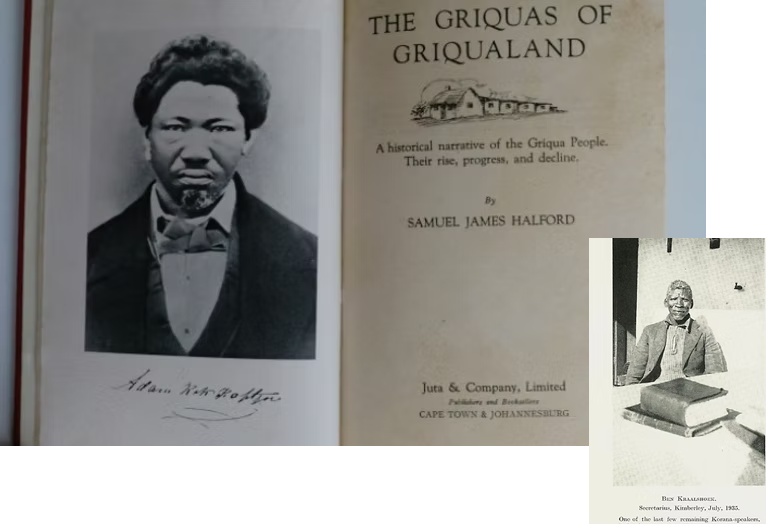
Only this historical event already demonstrates the ambiguous origin of the Griqua nation. The Griqua also adopted the Christian religion, which even nowadays is an important drive behind the revival of their cultural self awareness. Another feature that remembers us to the culture of the European settlers is that the Griqua speak the Afrikaner language as their mother tongue and strongly support its use as an official South African language. The 19th century was characterized by a huge and bloody conflict with the Boers who want to occupy the land around Griquatown and Philipolis, the residence of Adam Kok III, the leader of the Griqua at that time. When in 1861-1862 they were forced to sell out their land, Adam Kok III took the initiative to travel across the Drakensberg and to settle himself in Nomansland in the current Kwazulu-Natal. The new settlement was called Kokstad.
The Griqua struggle for Cultural Rights
When you ask the current leaders of the Griqua where they strife for, they will certainly answer ‘for self determination’. First of all the Griqua heritage has to be restored and a new consciousness has to be developed. People have to become self-confident again. They must dare to identify themselves as Griqua and must be proud of their roots. It is because of this that the Griqua leaders want, for example, that the Nmaqua language is being documented and that by interview sessions the knowledge of the older generation about natural cure, traditional customs, folk stories etc. is taped.
We may best describe the Griqua struggle for self determination as a struggle for the control of their own history and cultural heritage, the preservation of their own customs and practices and the regaining of the land stolen from them in the past. When we look to the actual claims that the Griqua are making, it is striking that their claims for self determination are rather modest. But they also know that it is far from realistic and even counterproductive to claim them, because much of their cultural and national heritage is already destroyed and the Griqua population is already scattered throughout the land. Therefore their claims only involve:
- Full and equal access to education, jobs and markets and the removal of stigmatizing categories like ‘black’, ‘coloured’ and ‘white’.
- The official recognition of their unique and crucial contribution to the history of South Africa (national symbols, language, educational curriculum, museums etc.)
- The land taken from their ancestors, in order to make a living, to do justice to their historical rights of ownership and to preserve their indigenous knowledge systems
A first example of a land claim is the case of the Kraalshoek Family in Bethanie. The territory has been owned since 1828 by the Griqua community, but has been incorporated in the 1848 by the British and given to the Berlin Missionary Association (Erasmus 2004: 9-16). In 1998 Captain Johannes Kraalshoek succeeded in gaining back again about 12.500 acres of the land occupied. Families who are in this struggle are White, Mouwers, Human, Loff, Bergman, Talmakies, Chebe, van Wyk, Links, Taaibosch, Links and various other families.
It holds great value to the Griqua because it is brought together as a nation again. What the Griqua community in the Knersvlakte claims is that its’ right of ownership (17.500 acres) is recognized, that they may benefit from new employment opportunities and that they have a considerable say in the development of the new reserve.
At best we may say that the Griqua, as other indigenous groups, strife for a rather thinned-out version of self-governmental rights.
Cultural Rights and Empowerment
The South of the Free State (Springfontein, Trompsburg, Phillippolis) makes us face the facts. In this area the Griqua population, as well as the other coloured people, face huge social problems. Most of the children drop out of primary school and there is a high unemployment rate. Also the living conditions are far from perfect. People live in shacks with asbestos roofs and open sewer. The children often live far away from their parents and when they have the opportunity to attend secondary school they are not able to follow courses in their mother tongue (Afrikaans). The infrastructure is poor and social and medical services far from optimal. Besides that the decisiveness and quality of the local government is, according to the people, a crying shame. As usual with disadvantaged groups also the Griqua population in the South of the Fr5ee State has to cope with a low self esteem and, related to that, a variety of moral problems: alcohol abuse, high incest rates (and accordingly a high percentage of HIV Aids casualties), stealing, ‘just to sit and rot’.
Taking stock of all these social and moral problems, one may really doubt if the struggle for cultural recognition should be the first concern of the Griqua. Most of the members of the Gri1qua population are not even aware of their historical and cultural roots.
Cultural Rights and Nationhood
Our second critical question concerns the adequacy of the self definition of the Griqua as being a national culture. First of all we may doubt if the nation of a national culture is still credible after all the critique given by social constructivist thinkers. Secondly we may doubt if the idea of a national culture is not obsolete in an age of globalization. And thirdly we discuss the problem that the definition of what belongs to a national culture strongly depends on internal power hierarchies.
Also the Griqua population with its mixed and ambiguous origin seems to answer this logic. It therefore sounds rather reasonable to describe them as an affinity group in the sense that Iris Marion Young is using the term. Affinity groups are not defined by a series of essential and inalienable features but share a collective history and social position which also influences their value orientation.
It is, however, very important to recognize that an emphasis on national identity not necessarily has to discharge into conservative or reactionary politics. It is not only the Traditional Leadership and Governance Framework Amendment Act of the South Africa Government enacted in 2003 which encouraged the revival of cultural awareness among the Khoi-San people as well as other indigenous groups, but also the growing international pressure to respect indigenous cultures, as exemplified for example by the UNDP Human Development Report 2004 (UNDP 2004). At the moment the Griqua nation has group representative rights within local governments as well as within national and international bodies.
References:
Erasmus, P. (2004) Die geskiedenis van die kraalshoek-familie van Bethanie in die Vrijstaat, Bloemfontein: Department of Antropology, University of the Free State, UNDP, 2004 Human Development Report 2004. Cultural liberty in today’s diverse world, New York: UNDP.